

Inside Passage, Part 2: Batteries are in.
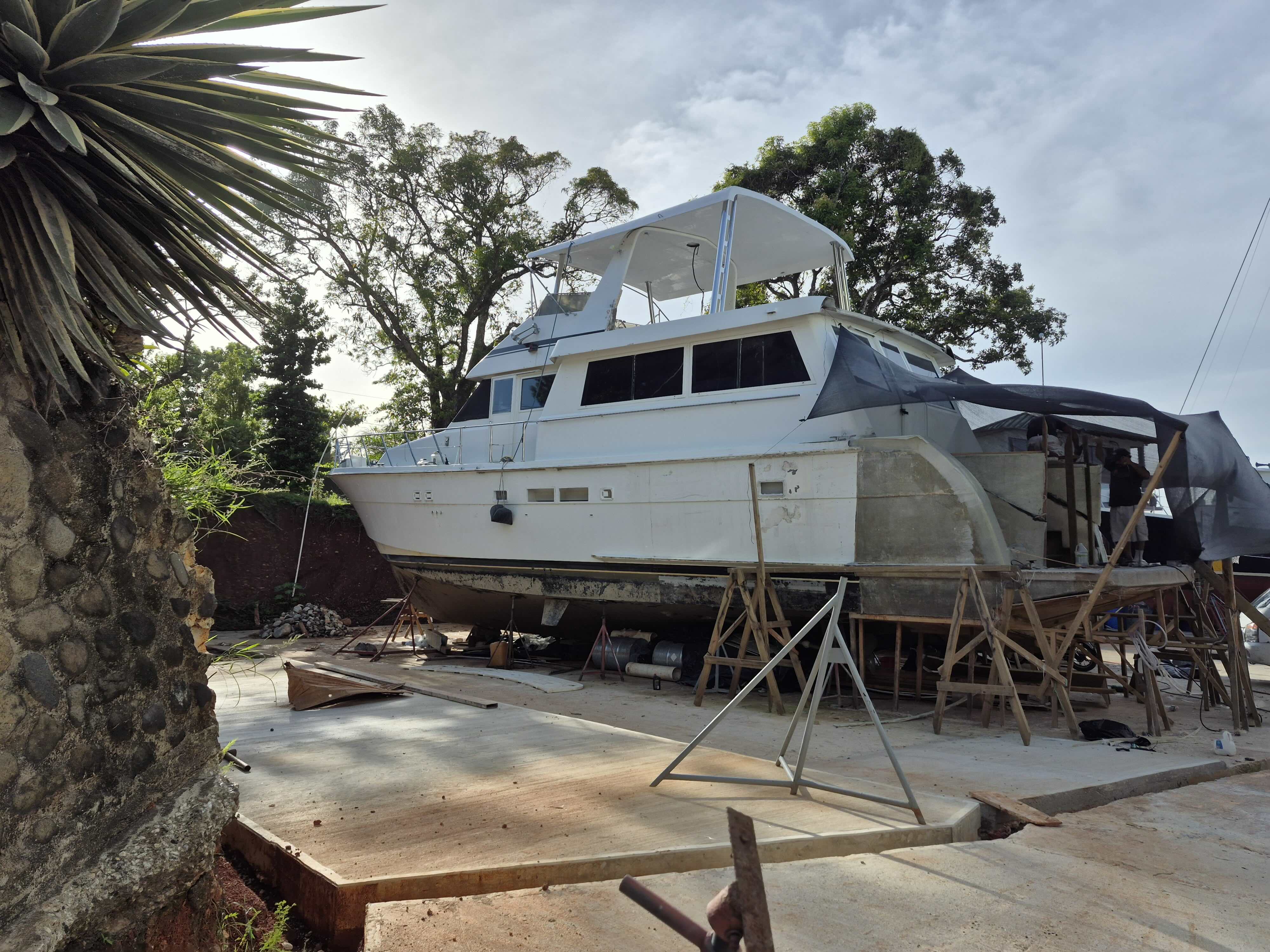
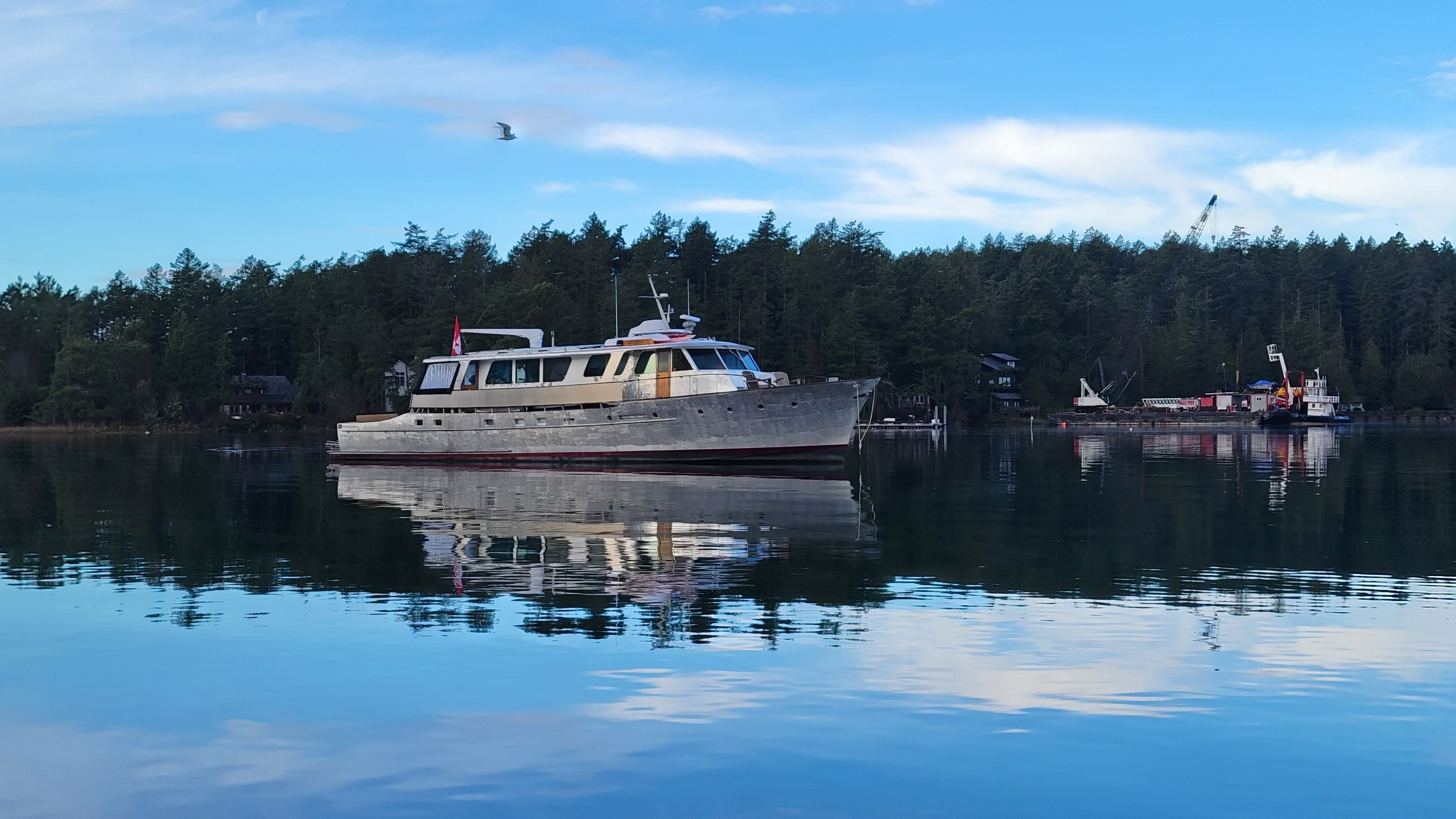
In Part 1, we stripped Inside Passage: a 1980s Chris-Craft 47 Rumrunner, a diesel that had run since she was new, lifted out through a door narrower than the engine. We designed the system and now it's ready to be installed— a 48V platform, two battery banks, an e-motor, and the generator.
From engine room to stern: a shift in battery location
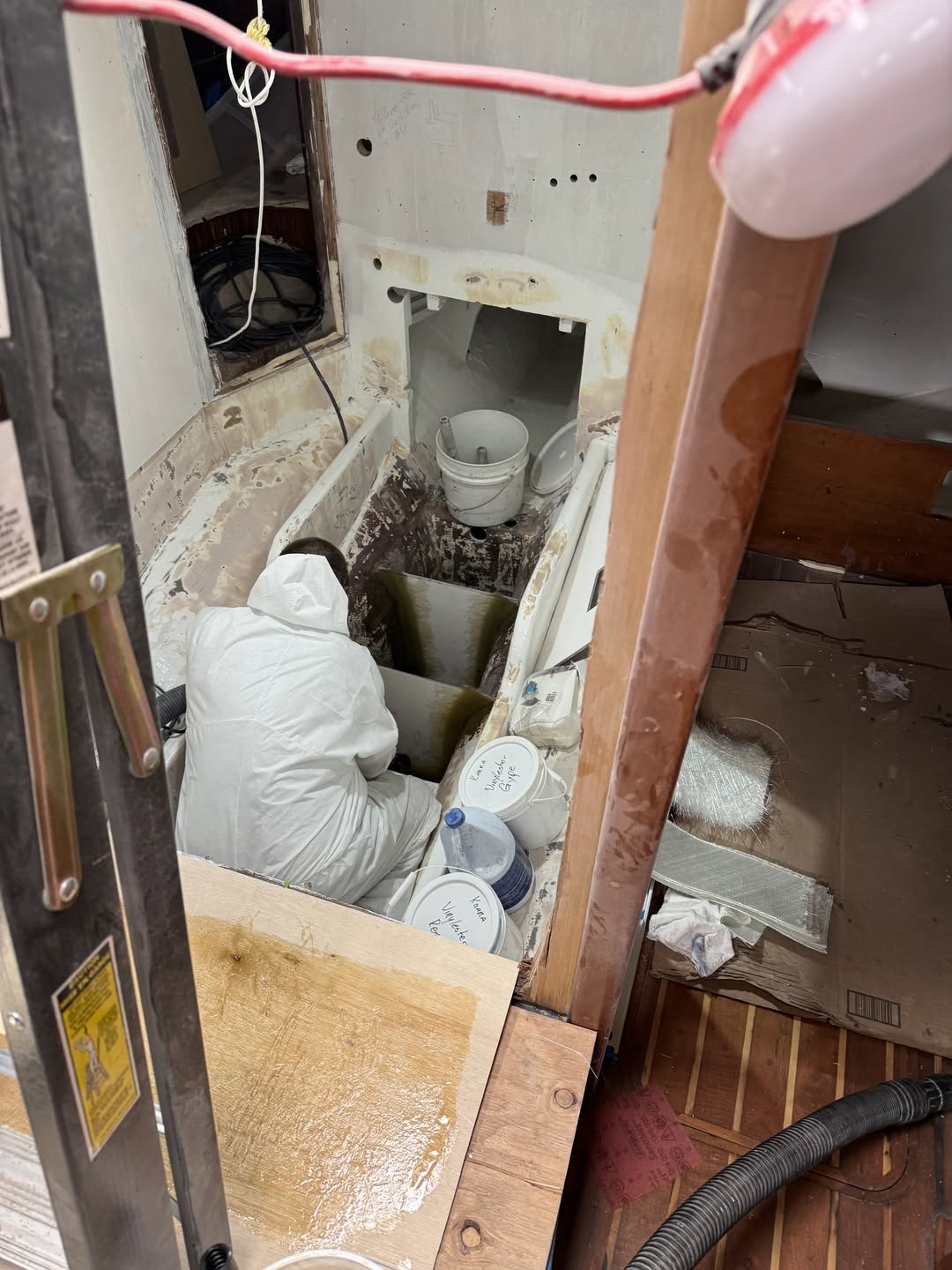
When Inside Passage came out of the water, we noticed she was riding a little high on the stern —so it made sense to rethink where the batteries would go. The stern, on top of the water tanks in the aft lazarette became their new home. Two 30 kWh modules, 540kg each.
Each module sits on a metal base plate that spreads its load across the tank tops, held in place by alloy angle retainers drilled and tapped into the bed. The slot overhangs the tank access lid slightly, so we split the bed — the battery is secure, but the water tank can still be opened for cleaning and service down the line. The modules went in by forklift, set down first on sawhorses, then eased down the last stretch on chain hoists and slid home — about an inch of clearance between the top of each battery and the beamabove it.
The system's main artery
Power runs from the stern to the machinery space along the system's main artery: solid bus bars run the length of the keel alley beneath the floorboards, from the batteries up to where the e-motor and generator live. That's how power moves back and forth — charging and discharging the bank.
A bar carrying that much current has to be isolated from any contact — cargo, gear, people, machinery, equipment. Two pieces of metal, or a hand, bridging the bars would create a dead short. So each bar is clad in heavy-duty shrink-wrap, then sleeved in a loose-fitting nylon cover that resists a knife edge. The work follows North American color coding: the yellow negative bar mounts low, , and the red positive bar as high as possible. The strapping is designed to hold the two bars a deliberate distance apart, so there's no path for current to develop between them.
Holding it all to the stringers is a nice piece of small-scale ingenuity. Rather than buy a part, we had brackets 3D-printed to the exact size of the bars. They cradle the bus bars in 250 lb nylon strapping: locked tight against the stringers so they can't move at all, but with enough freedom to let the bars expand and contract with heat as they operate.
Reusing the thrust bearing - and a belt-driven shaft
In the shaft alley, we've reused the boat's original thrust bearing — slimmed down from about ten inches to as little as possible, so the e-motor can sit as far aft as we can get it. The motor tucks into a pocket beneath the refrigerator, a tight trough that meant rotating the unit and turning every cooling fitting to 90° so the hoses lie flat against it, routed below the shaft where there's more room. It's a limited-access part — but with a designed service life around 900,000 hours, it almost never needs reaching. When it does need service, it can be slid down into the machinery room.
Then there's how the motor turns the shaft. Electric motors tend to spin faster than a propeller shaft wants to. One fix is a transmission — but a transmission is expensive, takes up space, and adds another point of failure. The approach Scott took avoids it, the e-motor sits on a spindle above the shaft and drives down to a different-sized spindle on the propeller shaft through an industrial belt, with the two wheel diameters sized to convert motor RPM to whatever the shaft needs. All the thrust loads onto the propeller shaft, never onto the motor. On Inside Passage the maximum is around 1,800 RPM at the shaft, which works well on most boats. The whole assembly mounts on a rail, so if the belts ever need attention, you uncouple the shaft and slide the platform into the machinery room. Those belts are essentially the only service part.
A modern engine room behind a 1980 face
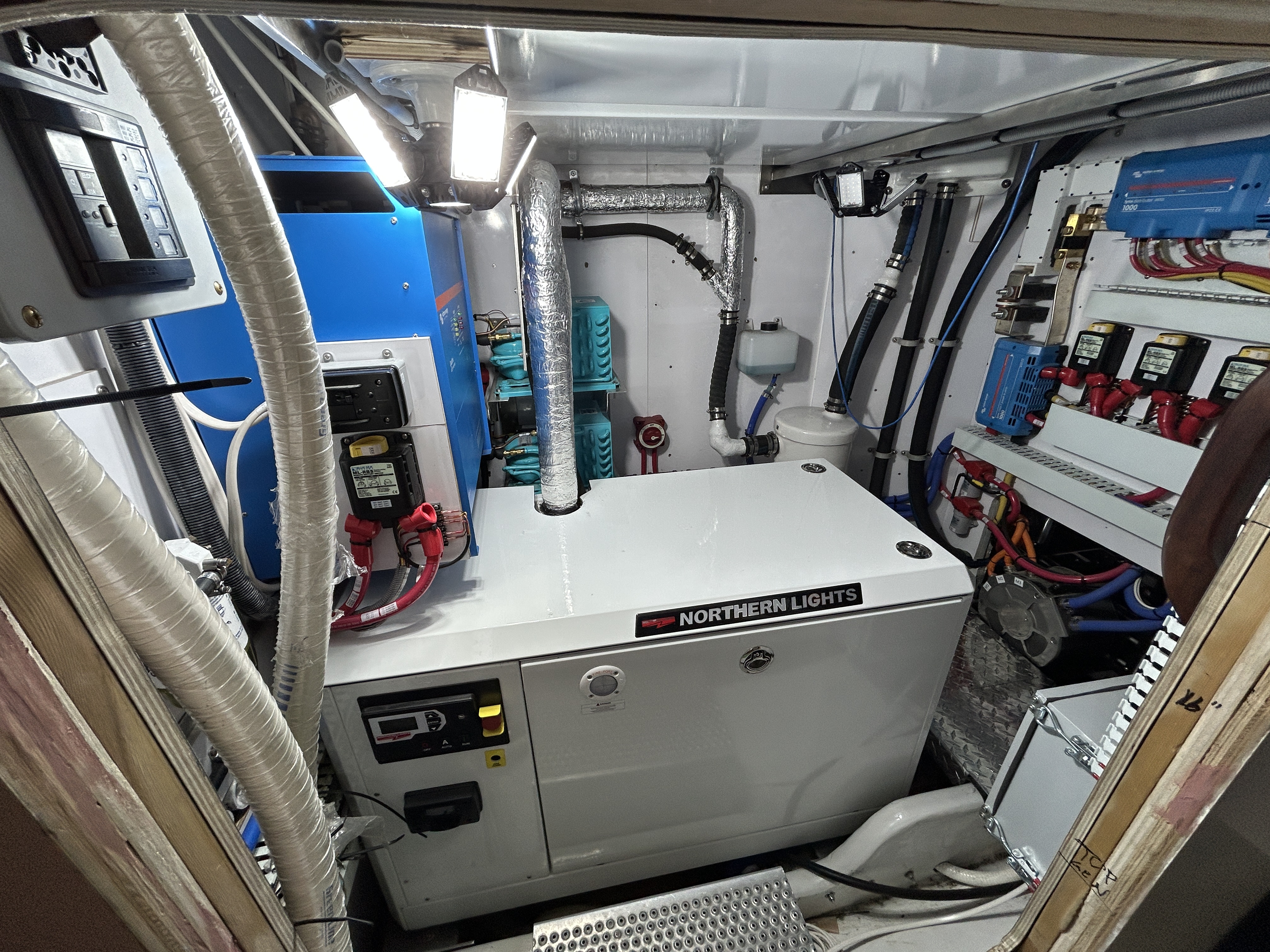
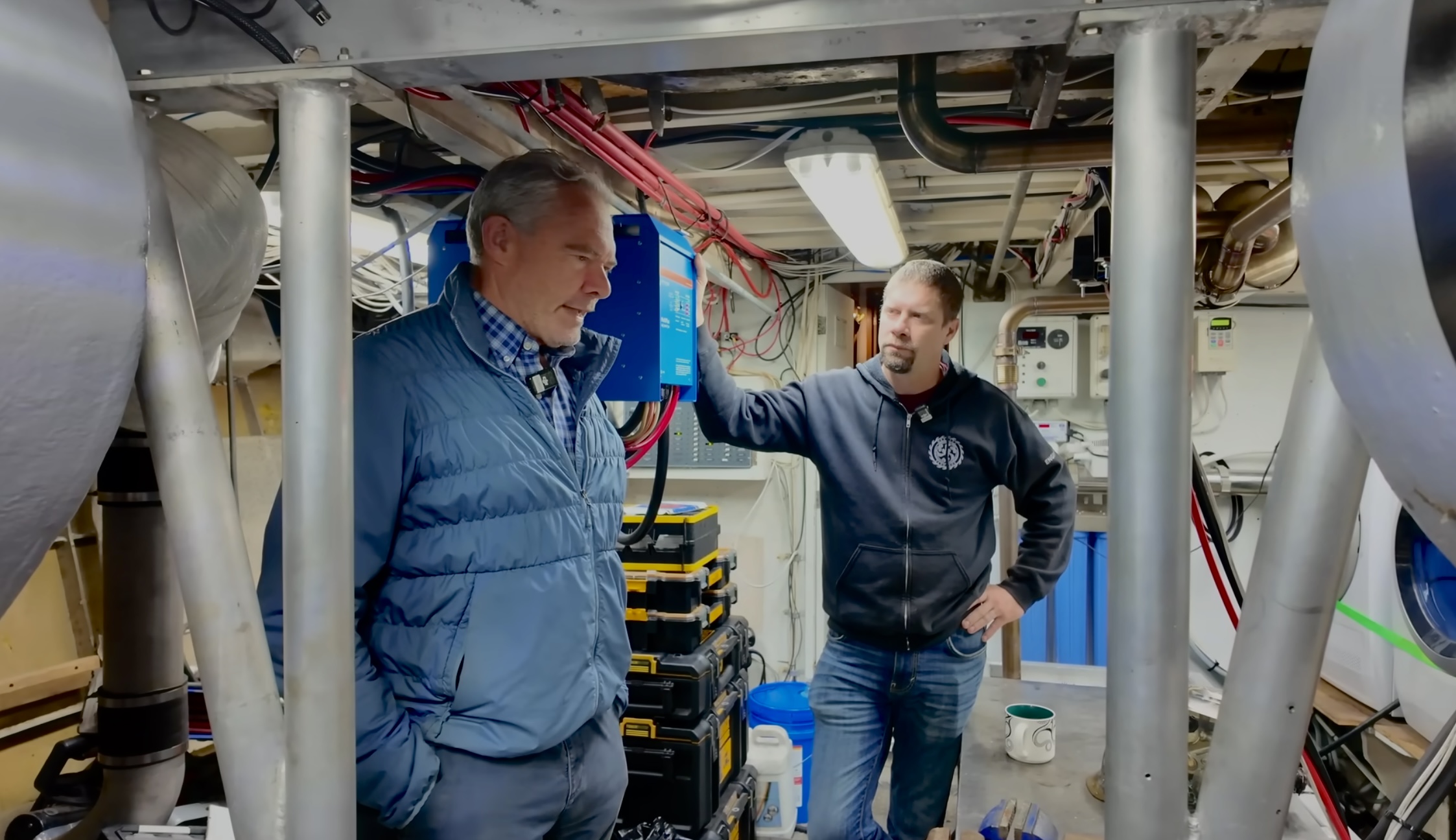
Inside Passage has a surprisingly spacious machinery room for a boat this size: That's where most of the new components, except the batteries, are being installed.
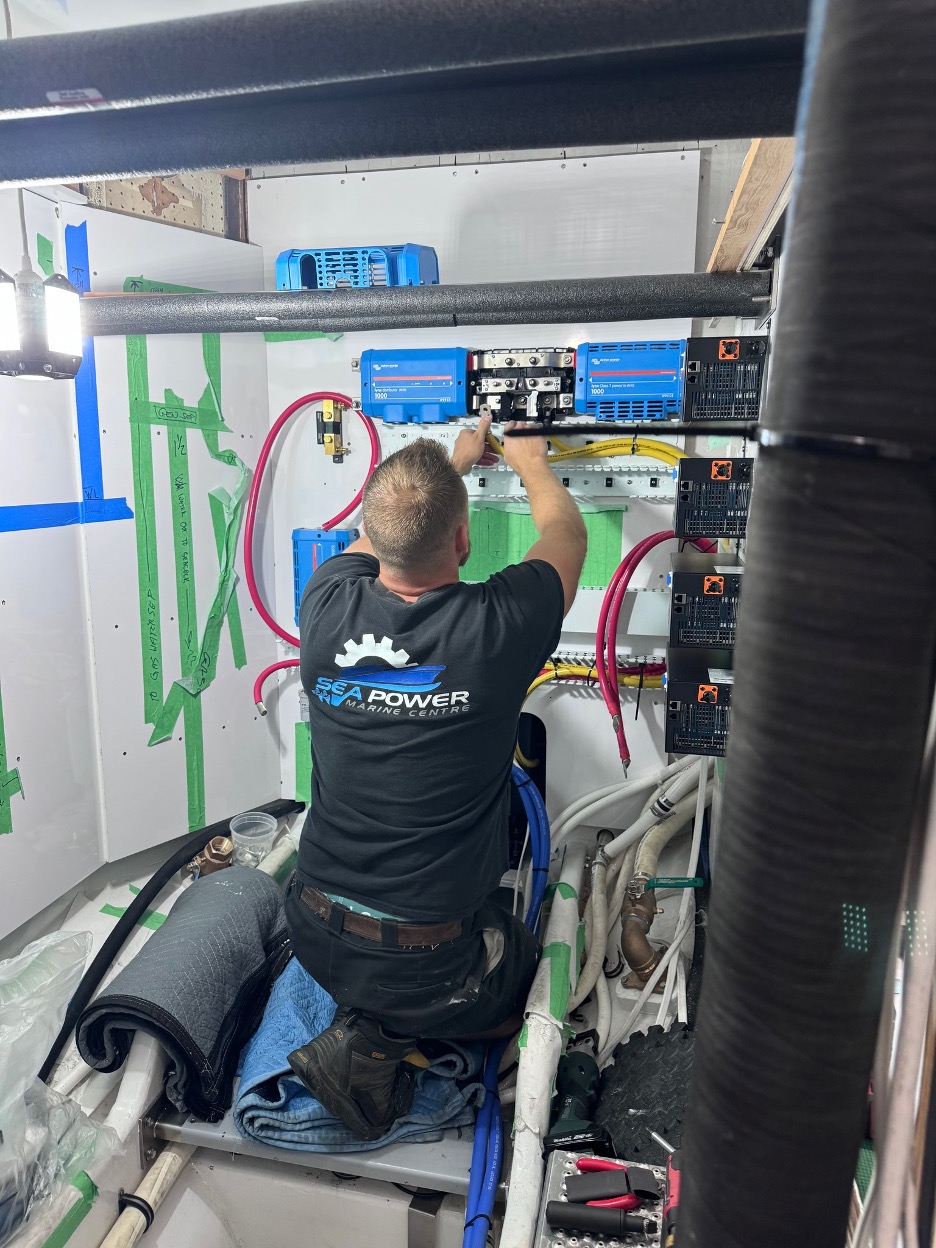
The e-motor tucks into the aft corner; the 15 kW DC generator sits fore-and-aft beneath the floor. Because the generator and motor sit within a few feet of each other, the power cables and motor controller live close to the back wall. Short runs, clean layout, very little wasted. Ken's been painting and prepping the floor so it comes up bright; a new aft bulkhead in high-gloss white laminate will carry the DC bus plates, leaving the side and forward walls free to organize the rest of the power electronics neatly.
There's a phrase we keep coming back to on this boat: a Millennium Falcon. From the outside, and even at the helm, she reads as an early-'80s vessel — and we mean to keep her that way. Ken kept the original Morse throttle control he's had on the boat since 1980. Rather than bolt on a modern unit that fights the boat's character, we modified the Morse internally so it now drives the electric motor. Same lever, same feel, so you only reach full power at the very top of the throw. (Not that you ever will: full power on this boat is unlikely.) Open the engine-room hatch, though, and it's another world — bright, glossy, modern, everything in its place.
The batteries
We went through the same world-wide search for Inside Passage that we did for Tangaroa, but at 48V the field is different. We landed on FreedomWon — a South African company that started back in 2009, and has since grown into a serious-scale builder.
Each module is 30 kWh in a sealed aluminum IP67 enclosure, sized to slide under the floor with an inch to spare. Two of them give Inside Passage two independent banks. A few things make these batteries well-suited to a boat:
- A built-in firefighting module. If a cell ever reached thermal runaway, suppression begins inside the module itself — mechanically triggered by temperature, nothing for a person to activate. Because the box is sealed to IP67, a fault can be isolated to that one battery while the other bank keeps the boat running.
- A resettable internal breaker on each module. It does the job a T-class fuse would normally do close to the battery — but where a blown fuse is an awkward, expensive thing to keep as a spare and replace, this simply resets. A genuinely better answer to a long-standing marine wiring problem.
- Built-in comms. Dedicated ports tie each battery into the Victron system that manages it, alongside the power outlets that run straight out to the bus bars in the keel alley.
Getting them aboard took some rigging. Each module came in on a forklift, set down first on sawhorses; the forklift then nosed back in for a little more height, and from there a couple of chain hoists lowered the battery the last stretch and slid it home under the floor — about an inch of clearance between the top of each module and the beam above it.
Where things stand
The batteries are in the stern. The e-motor is ready, the shaft alley and machinery space are prepped, the main artery is in, and the engine room is being painted out for final installation.
Next, the system gets wired together, and Inside Passage gets closer to being back on the water, silent.
For a closer look at the refit, visit the Onboard Tangaroa YouTube page:
https://www.youtube.com/watch?v=eV0jWgRPtiE&t=480s