


Here's a question worth sitting with: What if the technology you assumed was "emerging" had already been silently running millions of miles, carrying millions of people, in some of the most punishing marine environments on the planet — for the better part of two decades?
Because that's exactly what's happened.
While North American boaters debate whether electric propulsion is "ready," the commercial shipping world quietly moved on. Ferries the length of a football field. Ships running 365 days a year. Vessels hauling cars, trucks, and thousands of passengers across international waterways — all running on battery-electric power. Not as a pilot program. Not as a science experiment. As the daily workhorse.
The ships that changed everything
We’ve been in rooms where people said this would never work. We’ve also been in the rooms where we proved it did.
When we designed the Ampere, we spent three years optimizing every single component — hull shape, materials, every piece of equipment selected around one question: how do we make this as efficient as possible? The first time we ran the numbers, a single crossing consumed 350 kWh of energy. By the time we were done, we’d cut that to 175 kWh without changing a single performance characteristic. We nearly halved the energy consumption of a working commercial ferry just through disciplined engineering.
That’s the philosophy we’ve carried into every project since. Here are a few of the ships that show what it looks like in practice.
In February 2015, the MF Ampere —the world’s first fully electric car ferry — crossed Norway’s Sognefjord for the first time carrying 120 cars and 350 passengers. No diesel. No exhaust. Just batteries and a 20-minute crossing.
Ten years later, the Ampere has completed over 124,000 crossings. It has sailed the equivalent of 17 times around the equator on battery power alone. It saves roughly one million litres of diesel every single year. And the operational cost per crossing has dropped by 85 to 90% compared to the diesel ferry it replaced — generating nearly $15 million USD in total savings over its lifetime.
That’s not a promising pilot.That’s a decade of proof.
The success of the Ampere triggered a wave. Norway now operates over 100 electric ferries across 67routes. The technology was established, validated, and scaled — and by the time the rest of the world was ready to pay attention, it was already mature.
- The MF Ampere cut operational costs by 85–90%per crossing compared to diesel — generating nearly $15 million USD in totalsavings over a decade of operation.
Then came the next chapter. In2018, members of our team were involved in the conversion of two 111-metre car ferries — the Tycho Brahe and the Aurora — from diesel to full battery-electric operation on the Øresund strait between Sweden and Denmark. These weren’t new builds. They were 27-year-old workhorses, built in 1991, retrofitted mid-career and put straight back to a schedule that sees them cross an international waterway 20 minutes at a time, all day, every day, carrying over 7 million passengers and nearly 2 million vehicles a year.
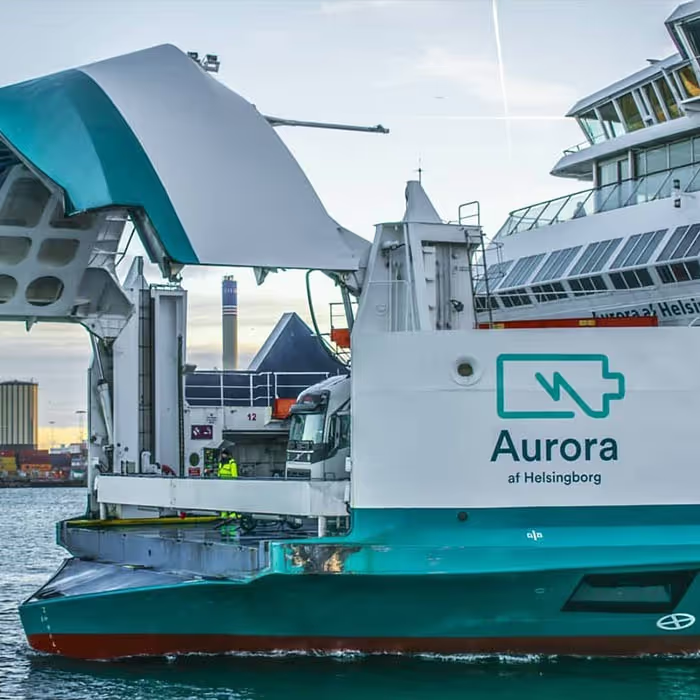
Each vessel was fitted with a4,160 kWh battery system — equivalent to the capacity of roughly 500 TeslaModel 3s — along with a fully integrated DC grid and automated robotic shore-charging stations. Since switching to battery power, the two ferries have eliminated over 37,000 tonnes of CO₂ — equal to what all four diesel ferries onthat route used to emit in an entire year.
And after decades of diesel exhaust and engine noise being pumped into that narrow strait, tuna returned to the area. Fish stocks —including cod — have been rising. Tuna hadn’t been seen in those waters for 40years.
Often, Emissions Weren't Even the Point
Here’s something that surprisesmost people: for the commercial operators who led this revolution, cuttingemissions wasn’t always the primary driver. Sometimes it wasn’t even in the topthree.
What actually moved the needle?Maintenance. Or more precisely — the brutal, unrelenting cost of notmaintaining a diesel-powered vessel.
Commercial ships run hard. Aworking ferry might log 4,000 to 8,000 hours a year. Every hour a vessel sitsin a shipyard for an engine overhaul, a generator rebuild, or a fuel systemrepair is an hour it isn’t earning. For operators running tight schedules,unplanned downtime isn’t just expensive — it’s existential. The push toelectrify was, in many cases, a push to get off the maintenance treadmill.
Electric propulsion systems havefar fewer moving parts than diesel engines. No combustion. No exhaust systems.No fuel injectors, turbochargers, or heat exchangers running at the edge oftheir tolerances. Generators in a hybrid-electric system run at constant speedand constant load — the single operating condition they were actually designedfor — which dramatically extends service intervals and makes failurespredictable rather than random.
Commercial operators who have madethe switch are reporting maintenance cost reductions of 30% or more. Some areseeing operational cost savings of 60 to 80% compared to their dieselpredecessors, when fuel and maintenance are combined.
For a recreational boater, themath hits differently — but the emotional logic is identical. The real cost ofa diesel breakdown isn’t just the repair bill. It’s the long weekend thatdidn’t happen. The trip you postponed. The summer your boat spent in a slip atthe yard instead of out on the water with your family. Electric propulsiondoesn’t just change what you spend at the boat yard. It changes how much timeyou actually spend on the water.
Where Did the Technology Come From?
It started with a superyacht.
Brent, OSĒA’s founder, was working on a high-end build when the owner came to him with a request: they wanted a battery hybrid-electric vessel. At the time, there was virtually nothing purpose-built for the job. The marine market didn’t have it. What existed was either adapted from other industries, under built for the demands of a working vessel, or simply not designed with the ocean in mind.
Brent started thinking about it from first principles. Strip away the assumptions, and what is a propulsion system really doing? It’s managing energy. A battery is just one form of energy storage. Diesel is just one method of energy generation. As long as you can generate energy reliably and store it efficiently, the physics work. The technology wasn’t the obstacle — the right engineering team and the right purpose-built components were.
What was built became the first commercially viable marine energy storage system designed from the ground up for the realities of the marine environment — the salt, the moisture, the vibration, the thermal extremes, the duty cycles that would destroy equipment built for any other application. Every component purpose-built. Every system engineered around how vessels actually operate.
That work laid the foundation for what became an entirely new category of commercial marine technology. Companies like Corvus Energy (founded by Brent Perry and his team)— which today powers more than 90% of large commercial hybrid vessels worldwide — grew from that pioneering era. The first all-electric fast ferry, the first electric harbour tugboat, the first electric commercial fishing vessel, the first hybrid cruise ship.
When OSĒA was founded, the mission evolved. Not just building the core technology anymore — but taking everything learned at commercial scale and bringing it to the full range of vessels that deserved the same standard: the workboats, the fishing vessels, the expedition yachts, and yes, the private boats whose owners have been told this technology isn’t ready for them yet.
It’s been ready for a long time.